








 My blog
  Support me on Tipeee!




Wednesday30October
Japan, here we come! We're flying from Nantes to Munich, a short German stopover before the big flight to Osaka, the megalopolis in the south of Honshu Island, the largest of Japan's islands.
Thursday31stOctober
11 hours after taking off from Munich, we practically land on the sea because Kansai Airport is built on an artificial island in Osaka Bay... 

Kansai Airport with the 3.7-kilometer bridge connecting to Osaka behind it.
Osaka is only a stopover because our first week takes place on another island of Japan, smaller and far to the north: Honshu. So we take the plane again which takes us to Chitose in 2 hours of flight. We arrive at dusk and start by picking up our first rental car and joining our first hotel: the "Air Hostel LCC".
The entrance to the hotel where the first thing to do, and this will always be the case, is to swap our shoes for slippers or other crocs provided. This is the only hotel we booked from France. The others, we will book either the day before online, or directly by going there. The most efficient will be online booking...


The other essential of the country... Japanese toilets, of course!  This shot is not unique as they are present everywhere we went. Whether in public places or restaurants, they are always there!


A control to activate the water jet, one button for ladies and another for the power of the water jet... 
For this first evening, we stumbled upon this traditional restaurant somewhat by chance. Its cuisine, known as "kaiseki", consists of several small dishes served individually. We were given a private room where we could enjoy all our small dishes chosen thanks to the menu photos! A delight! 


Friday1stNovember
Self-prepared breakfast in the common kitchen at our hotel "Air Hostel LCC".


And so begins our road trip on Honshu Island. Our vehicle will be a Toyota Sienta... Unknown in Europe but very modern and well-equipped. As you can see in the photo, the steering wheel is on the right. Indeed, we will have to drive on the left, a small constraint quickly mastered. Here, we will only drive on country roads, so not too many difficulties. And we will rely almost entirely on our own GPS installed on our phones. No need to decipher signs in Japanese writing (Kanji characters). Phew! 

A short stop on the road that takes us to the north of the island in the Lake Mashu region. The autumn colors are very present. This bodes well!


Picnic in the Shimizu drive-in parking lot...

A rest area with its toilets in a cistern...


The road was longer than expected. We arrive at night and are very vigilant because we encounter some groups of deer: sika deer (Cervus nippon).

Teshikaga
We stop in Teshikaga, a small town near Lake Mashu, and choose the Masyu hotel for the night. After the traditional restaurant of the previous day, we will be able to test typical rooms by sleeping on futons. The hotel is not quite a Ryokan (traditional inns) because it is too large to have the appellation, but it comes close. Indeed, in addition to its rooms with futons, the hotel has an onsen! The onsen is a must-see in the country. These are hot baths with well-defined rituals. Indeed, you must bathe completely naked and after having thoroughly washed yourself while sitting on a stool. But I will have the opportunity to come back to this later in my story! 


The Japanese futon: the traditional Japanese mattress placed directly on the floor with a single large duvet as a blanket.
Dinner takes us to a Ramen restaurant, these large bowls of noodles submerged in a meat or fish soup.


"There are many variations of ramen, and many possible accompaniments. Among the most classic are meat, often chāshū (long-braised pork), marinated eggs (ajitsuke tamago), a type of soft-boiled egg cooked in a soy sauce broth, menma (fermented bamboo), spring onion, black mushrooms, gari (pickled ginger), butter, corn, nori (dried seaweed), garlic or a spiral-shaped piece of narutomaki (uzumaki), depending on the recipe." © Wikipedia


Saturday2ndNovember
Lake Mashu
The first activity of our Japanese journey will be the most strenuous of our 4 weeks, physically speaking. Suffice to say that the stay will be rather calm compared to other years . This hike around the lake will take us 2h30 to the summit of the small Mount Kamui at 857 meters altitude.

The beautiful relief seen from the site's parking lot.
And on the other side, the star of the day: Lake Mashu. "It is an endorheic crater lake in the caldera of a potentially active volcano. The lake is renowned as one of the clearest lakes in the world." © Wikipedia


Commemorative plaque? No idea, I haven't found the translation...


Here we are at the starting point of the short walk to reach the small Mount Kamui-Nupuri (the other name for Mount Mashu) 7.2 km away.


The area is covered with "Sasa nipponica", a plant from the bamboo family.


We are almost halfway there. We have already covered 3.1 km, we have 4.1 km left to reach Mount Mashu.

The weather is perfect. Endless sunshine and very cool but very pleasant temperatures for a hike.

Beautiful landscape with gentle rolling hills taking on touches of autumn colors.


The goal is to climb to the ridge at the top left of this photo.


Nice intermediate viewpoint.


We are approaching the ridge.

The last few meters are a bit steeper.


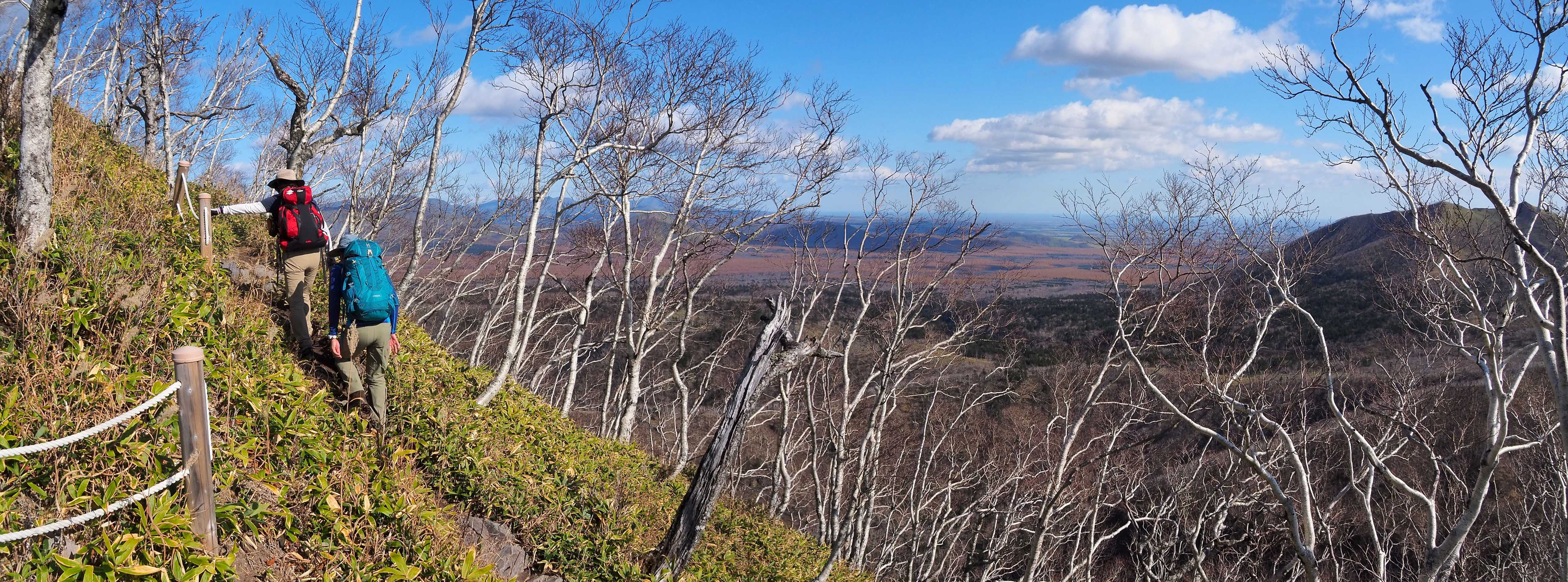


And there you have it, 2h30 later we are at 857 meters at the summit of Mount Mashu and its superb view of the eponymous lake. 


One of the most beautiful views Japan will offer us 


And off we go, it's not all about climbing up here, but we have to think about coming back down... 2 painful hours traversing the slopes of this caldera. Perhaps a bit violent for a first day. My back will remind me of it in a few days... 


The berries of the "tree killer" (Celastrus orbiculatus). Quite a program...
Mount Io Zan Hot Spring
After these 5 hours of walking, we continue with another site where columns of smoke escape from the ground. We are in front of the fumaroles of Mount Io Zan.

This volcano was formerly exploited for its sulfur deposits.


The yellow sulfur deposits.

The yellow mounds form over time at ground level where hydrogen sulfide vapors oxidize upon contact with air and fall back as sulfur particles.


Solfataras grow in "fractals" in the form of fine needles.


Small pools of water bordered by beads, results of other chemical reactions.


The red fox
We leave the solfataras to reach the next Café indicated on our GPS navigator. On the way to the hot drink dispenser, we cross paths with the God Inari, yes ladies and gentlemen, nothing less than that, the God Inari Guardian of houses... Indeed, the fox, here a red fox of its species (Vulpes vulpes schrencki) represents on earth the God Inari whom we will soon encounter in shrines, in the form of a stone statue (also called Kitsune). This time, he is truly in flesh and blood and gives us the pleasure of taking his time so that we can adjust (quickly nonetheless) our cameras...


The coffee and sweets
Goal achieved, here we are in front of the "Coffee and Sweets" café.

The coffee is truly served according to the rules of art with its small chocolates, milk, and a glass of water...

In front of us, birds are busy looking for sunflower seeds. This will make me want to install exactly the same version on my terrace two months later...


Return to Utoro where we are staying at Shiretoko Village.

The hotel's common room
We've been in Japan for 2 days and haven't eaten yakitori yet!? That's fixed tonight at Namishibuki restaurant! Yakitori are small skewers made to be eaten directly with the mouth and often accompanied by a bowl of rice and a sweet or savory soy sauce. Delicious as long as you know what you're ordering! Indeed, we sometimes come across chicken skin or combs... 


Back to the hotel. Oh yes, I forgot, it's a capsule hotel! Yes, we're experiencing the country's unique features one after another. The room offered by the hotel is reduced to these small boxes the size of the mattress. Generally, a TV enhances the capsule, but here we only get light, which is not bad at all.


And again, the hotel is equipped with an Onsen! Yes, this essential of Japan. Let me remind you of the principle: go wash and bathe in naturally hot waters, and completely naked... It's a totally normal and natural practice for Japanese people. The goal is to relax for a few minutes in the basin (the water can exceed 40 degrees) but in doing so, it is unthinkable to soil this natural water, so you must meticulously wash yourself completely before entering. This washing is done just in front of the basin on a small stool in front of a mirror. Everything is provided, shower gel, shampoo, and conditioner. And completely naked, you lather and rinse yourself with the showerhead several times... Very curious the first time, especially with strangers, but ultimately it's no more surprising than football changing rooms... Except that here, calm and silence are mandatory!

Onsen means "hot spring" in Japanese. So we can say that this bath in the simplest attire is a return to basics!...
Sunday3rdNovember
A new day which, as often, begins with a visit to convenience stores, another essential of the country. We will frequent mainly 3 stores: 7/11 ("Seven/Eleven"), Familymart, and Dawson. So here we are in front of a 7/11 where we make small purchases for a midday picnic. The stores even offer hot yakitori.

Furepe falls
First stop of the day, Furepe waterfall.

At the end of the cliff, Furepe lighthouse.


The cliff rock reveals the site's volcanic past. The thick-billed raven (Corvus macrorhynchos) observing us from the corner of its eye will certainly not contradict me...


Shiretokogoko park
The next site plunges us into the 'Sasa nipponica', these low-growing bamboos. We are in Shiretoko National Park.


Shiretoko Goko is composed of 5 lakes (goko means five) that we walk around one after the other, encountering among other birds, whooper swans (Cygnus cygnus).


The route ends with a long elevated pontoon above a lake not of water but of Sasa nipponica...


The entire Shiretoko Peninsula has been a UNESCO World Heritage site since 2005, notably for its particularly rich fauna and flora.


Again, a thick-billed raven (Corvus macrorhynchos) comes to be curious and try to impress the onlookers who are finishing their exploratory walk...


"In Japan, wild ravens are considered a pest because they have learned to open garbage bags (whose closing strings they sometimes use to incorporate into their nests)." © Wikipedia


We leave the five lakes and, in exchange, cross paths with five Sika deer (Cervus nippon). This cervid originates from the region (hence its Latin name), particularly in the Shiretoko Peninsula where they are very numerous.


This male deer has 8 antlers... or rather, on its antlers. That's the number of 'branches' that make up its antler... Yes, that's also the name given to these ramifications that adorn its skull...

Utoro
Back to Utoro where we are staying.


Not far from the town flow two small waterfalls. Here, those of Sandan falls.


And here, the one named Oshinkoshin waterfall.


Attention must always be heightened when driving in the peninsula. Deer look for their food without regard for paved roads...

Their slightly white-spotted backs are much less so than their immaculate hindquarters...


A little further on, we are suddenly struck, impressed by the discreet but nonetheless majestic presence of what appears to be the monarch of the area... If the lion is the king of the jungle, the deer is clearly the king of the forest...


Back to yesterday's onsen. Nothing beats it for relaxing and recovering from a busy day. Before conscientiously washing, you must leave all your clothes in the baskets provided for this purpose in the adjoining room.


The overall view of the onsen with its 8 showerheads and the basin overlooking the vegetated exterior. In the middle of the tiling, the stacked stools that you must take before sitting in front of the mirrors where liquid soap, shampoo, and conditioner are provided.

We changed hotels because, remember, we were in a capsule. So we prefer to return to the classic beds of the Iruka hotel. A cafeteria is available where we can devour our latest purchases from the 7/11 in town...


From left to right: dehydrated wasabi peas (the green Japanese condiment as powerful as our mustard), the classic and essential maki (rice rolled in seaweed sheets with vegetables or fish in the center), and finally, dried beef.


For the most curious, you will have noticed the price of the 12 makis: 280 yen, which is about 2.40 euros. An affordable price, much more so than in the country's restaurants, which is why we will take full advantage of Japanese convenience stores!
Latest comments
On Guatemala 2018
Le 25 Novembre 2024
Significado de este mural
On Chile 2016
Le 15 Septembre 2024
Rrrrrr
On Egypt 2003
Le 1er Avril 2023
Et oui c'est bien nous aux pieds de ce Colosse !
Le 1er Avril 2023
Bien petits aux pieds de ce Colosse !
On Namibia 2014
Le 3 Août 2021
very good indeed