







 My blog
  Support me on Tipeee!




Wednesday3November
Archaeological Museum of Pella
We left the big city of Thessaloniki behind us, and here we are already plunged back into antiquity in the ancient city of Pella, capital of the kingdom of Macedonia, and above all birthplace of Alexander the Great, excuse the little.  We start with the museum.

"Alexander the Great or Alexander III, born July 21, 356 BC in Pella and died June 11, 323 BC in Babylon, is a king of Macedonia and one of the most famous figures of Antiquity. Son of Philip II, student of Aristotle and king of Macedonia from 336, he becomes one of the greatest conquerors in history by taking possession of the immense Persian Empire and advancing to the banks of the Indus." © Wikipedia


Details of the Lion Hunt Mosaic (late 4th century BC).


Coin and bronze helmet.


Excavations also revealed skeletons dating from the Bronze Age (3000 BC).


Mosaic of Dionysus


Stag Hunt Mosaic (4th century BC).


Gold mask (550-540 BC) and gold myrtle wreath (325-300 BC).


Archaeological site of Pella
"A first small-scale excavation was carried out in 1914-1915 by G. OIKONOMOS, but the systematic exploration of the site only began in 1953, and excavations in 1957, under the direction of Ph. PETSAS. A first series of campaigns ended in 1963, then excavations resumed in 1976 and are still continuing regularly in the agora sector." © Wikipedia


We find the Stag Hunt Mosaic which covers the floor of the House of the Abduction of Helen.


The Roman baths.


And hop, here we are already on the road to get closer to the next archaeological site that we will visit tomorrow: Aigai.

The long E90 road with wind turbines in sight at the very top of the mountains...
We will spend a night in Vergina at the Aigon Hotel, located just next to the ancient city Aigai.


Dinner at the restaurant "G???a ???a", in Greek in the text... Which means "Elia's Corner"? 

Thursday4November
Archaeological site of Aigai
Here we go for the discovery of the tombs of Aigai! Aigai was the first capital of the Kingdom of Macedonia. The entire archaeological site has been classified as a UNESCO World Heritage Site since 1996. Excavations in Vergina revealed eleven tombs including that of King Philip II, father of Alexander the Great.

The entrance plunges us into the darkness of the tumulus of 100 m in diameter housing the museum surrounded by royal tombs.
Funerary steles.


On the right, funerary object from the graves of three warriors from the 4th century BC. On the left, bas-relief of a dead young man represented with his young servant and his dog.


Fragments of clay figurines found in Tomb IV (3rd century BC).


The north wall of tomb I.

"The Abduction of Persephone"


"Demeter"


The weapons of Philip II (336 BC): Two spears, two greaves of armor protecting his lower legs, a shield and an iron sword with wooden scabbard, decorated with ivory.


And here is the tomb of Philip II. It would never have been visited since its construction in 336 BC until its discovery in 1977. Although some archaeologists dispute its identification and lean more towards Philip III (son of Philip II and half-brother of Alexander the Great), the vast majority seem to finally converge towards the father, Philip II.


It is not immediately distinguished, but the entire upper part is a fresco representing a hunting scene.
Details of the facade.


Detail of hunters on their horses represented on the fresco.


The dim light inside the tumulus makes the visit very pleasant, highlighting only the treasures of the museum.

The gold larnax found in the tomb of Philip II, having probably contained the remains of his 6th wife, Princess Meda of Thrace.


The gold diadem of the supposed Princess Meda of Thrace.

A chryselephantine couch (which means made of ivory and wood) was found in the antechamber of Philip II's tomb. The decorative friezes represented scenes of combat and victory. Since the different elements (men and horses) were made of wood for the dressed parts and ivory for the rest, only the ivory survived the passage of centuries, giving these small fragmented characters.


We are now in front of tomb III, that of Prince Alexander IV, son of Alexander the Great and Roxana. Born two months after his father's death, he was assassinated at the age of 13 with his mother.


Details of the facade.


Again, a chryselephantine couch was present in the tomb. This is a scene with Dionysus, a torch in hand, holding his companion by the shoulder, and following a young Pan playing the flute.


The gold wreath of oak leaves of the young prince with the silver ossuary that contained his bones.


Chariot race on the fresco in the antechamber of the tomb of Alexander IV, in tomb III.

The two greaves of armor of Alexander IV.


Back to Philip II and his armor displayed in the center of the museum. It is made of linen with iron sheets, lined with leather.


The gold buttons in lion heads that button the cuirass are royal symbols. And detail of the iron helmet with the bust in relief of the goddess Athena.


Here, the gold chest that contained the bones of King Philip II. Placed above, his oak wreath that he wore when he was cremated on the pyre.
"When the body had been burned, all the bones were collected with great care and washed with wine: the purple cloth was spread on the bottom of the chest, which would have been part of the treasure of the royal house, and the bones were carefully arranged in order first the feet, then the trunk and at the top the skull, which they covered with the purple cloth, above which they placed the gold wreath, then sealed the chest inside the marble sarcophagus, which had also been built with it. Finally, in front of it, they placed the wooden couch and around it the weapons and other objects. Then, closing the heavy marble doors of the chamber, they dropped the wedge that would seal it forever".
Andronikos Vergina, discoverer of the tomb of Philip II.


After the chryselephantine couch of the antechamber of Philip II's tomb (and that of his grandson Alexander IV), here is that of the main room.


Andronikos Vergina (1919-1992), anthropologist, art historian and archaeologist.
"And then (after opening the sarcophagus) we saw something I could never have imagined (...) a solid gold chest with an impressive star in relief on its lid. We took it out of the sarcophagus, placed it on the floor and opened it. Our eyes almost popped out of our heads and we caught our breath (...). All signs were that we had found a royal tomb, and if the dating we had attributed to the objects was correct, as it seemed to be, then... I didn't even dare to think about it. For the first time, I felt a shiver run down my spine, as if an electric shock had gone through me. If the dating... and they were royal remains... then... had I held Philip's bones in my hands?"
Andronikos Vergina
We leave the museum and its tombs to join, a little further south of the city, the remains of the ancient capital of Macedonia: Aigai, discovered and identified since 1968.

It is noon, and the fog does not leave the neighboring fields.

The entrance to the Theater of Aigai.


In the distance, the small town of Vergina.


The Nymphaeum of Mieza
The visit of Aigai is quick and we take the opportunity to make a small jump to Naousa, a small town located 30 kilometers from Vergina. This city, by its ancient name Mieza, hosted for three years one of the most famous philosophers of antiquity (with Plato his teacher): Aristotle... It is indeed here at the Nymphaeum of Mieza that Aristotle will dispense his teaching to Alexander the Great.

Statue of Aristotle
It is therefore here that Alexander the Great followed his "schooling" with Aristotle.

A small cave that is reminiscent of Plato's in his allegory of the cave. But it is indeed his disciple, Aristotle who will be the tutor of the future king of Macedonia.


We join Naousa to visit its basilica Saint-Menas.


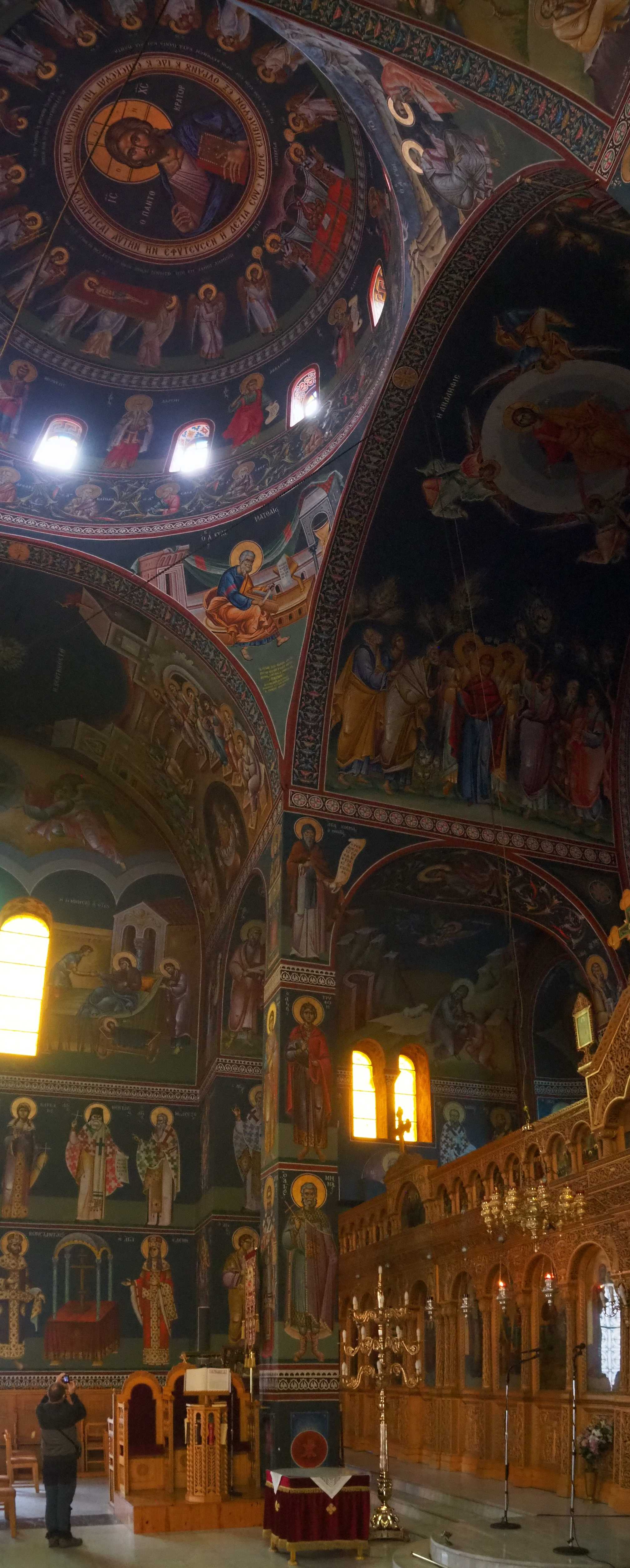


Saint Constantine and his mother Helen. And Saint Christopher.


The Assumption of the Virgin.


And then restaurant, still in Naoussa, with one of the best dishes we have eaten in Greece: a stifádo or beef bourguignon Greek style! Veal sauté, olive oil, onion, tomato juice, vinegar, red wine and bay leaf! And for dessert, a Baklava, layers of filo dough soaked in honey...;;


The Meteora
And it is 2.5 hours after this delicious meal that we arrive in Kalambaka, the small town at the foot of the highlight of our trip: the Meteora! We arrive at night and the huge illuminated rocky peaks give us a superb glimpse of the next two days...

Latest comments
On Guatemala 2018
Le 25 Novembre 2024
Significado de este mural
On Chile 2016
Le 15 Septembre 2024
Rrrrrr
On Egypt 2003
Le 1er Avril 2023
Et oui c'est bien nous aux pieds de ce Colosse !
Le 1er Avril 2023
Bien petits aux pieds de ce Colosse !
On Namibia 2014
Le 3 Août 2021
very good indeed